
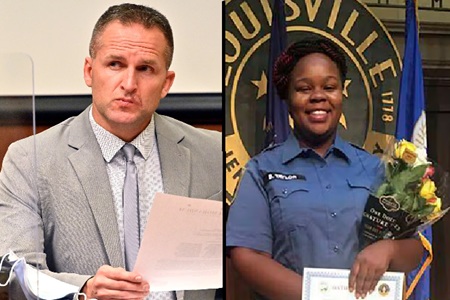
The U.S. Department of Justice (DOJ) has moved to dismiss federal criminal charges against two former Louisville police officers accused of falsifying information used to obtain the search warrant that led to the 2020 raid in which Breonna Taylor was killed.
In a court filing, federal prosecutors asked a judge to dismiss the case “with prejudice,” meaning the charges could not be brought again if the request is approved.
The motion represents a significant step toward closing one of the remaining federal cases tied to the controversial raid that sparked nationwide protests over police accountability and racial justice.
The former officers, Joshua Jaynes and Kyle Meany, were accused of violating Taylor’s civil rights by allegedly providing misleading or false information to secure a warrant to search her apartment.
Prosecutors argued that the warrant played a role in setting the events of the March 13, 2020 raid in motion.
The case has faced repeated legal setbacks in federal court. Judges previously reduced the original felony charges to misdemeanors, signaling concerns about whether prosecutors could meet the high burden required to prove willful civil rights violations beyond a reasonable doubt.
Breonna Taylor, a 26-year-old emergency medical worker, was killed when officers executed a warrant at her apartment while investigating a suspected drug operation involving a former boyfriend. During the raid, Taylor’s boyfriend, Kenneth Walker, fired a shot he believed was directed at intruders, prompting officers to return fire.
Three officers were directly involved in the shooting:
- Jonathan Mattingly and Myles Cosgrove fired the shots that struck and killed Taylor.
- Brett Hankison fired into the apartment and neighboring units, though his shots did not hit Taylor.
Hankison later faced federal civil rights charges and was convicted for using excessive force. In that separate phase of the case, the Department of Justice has at times recommended a minimal sentence, reflecting its assessment of the specific conviction and applicable sentencing guidelines. The sentencing decision ultimately rests with the judge.
Separately, the federal case involving Jaynes and Meany focuses on their alleged role in the warrant process rather than the shooting itself. If the court grants the DOJ’s motion to dismiss, the federal prosecution against them would effectively end.
The broader legal aftermath of Taylor’s death has included state and federal investigations, civil litigation, and a $12 million settlement between the city of Louisville and Taylor’s family in 2020. Some criminal proceedings have concluded without convictions, while others resulted in charges or convictions that were later narrowed or challenged in court.
The DOJ’s latest move underscores the legal complexity surrounding the case and highlights the challenges prosecutors face in sustaining criminal civil rights charges tied to police conduct. If approved by the court, it would mark another major development in a case that continues to draw national attention years after the incident.
Video/Story Credit: www.cbsnews.com